Strategy Order Types Explained: Why Market, Limit, and Stop Orders Matter in Backtesting
How the order type you choose can silently make or break your backtest results.
One of the easiest ways to overestimate a trading strategy is to focus on the signal logic and ignore the order type used to execute it. This guide explains the differences between market, limit, and stop orders in TradingView strategy development — and why realistic execution assumptions are essential for honest backtesting.
One of the easiest ways to overestimate a trading strategy is to focus on the signal logic and ignore the order type used to execute it. A crossover, breakout, or pullback may look excellent in a backtest, but the moment you change how the strategy actually enters the market, the results can change materially.
That is why order types deserve much more attention in strategy design. It is also one of the reasons The 10 Rules of Genuine Backtesting in TradingView puts so much emphasis on realistic assumptions rather than headline results.
Order types are one of the hidden reasons strategies fail in live trading even when the logic looked sound in backtesting. The signal may be valid, but the execution assumptions may be unrealistic. In practice, the difference between a market entry, a limit entry, and a stop entry can determine whether you get filled, when you get filled, and whether the trade still has edge after costs and slippage.
This is especially important in TradingView strategy development, because the backtester is only as realistic as the assumptions built into the script and the discipline of the developer writing it.
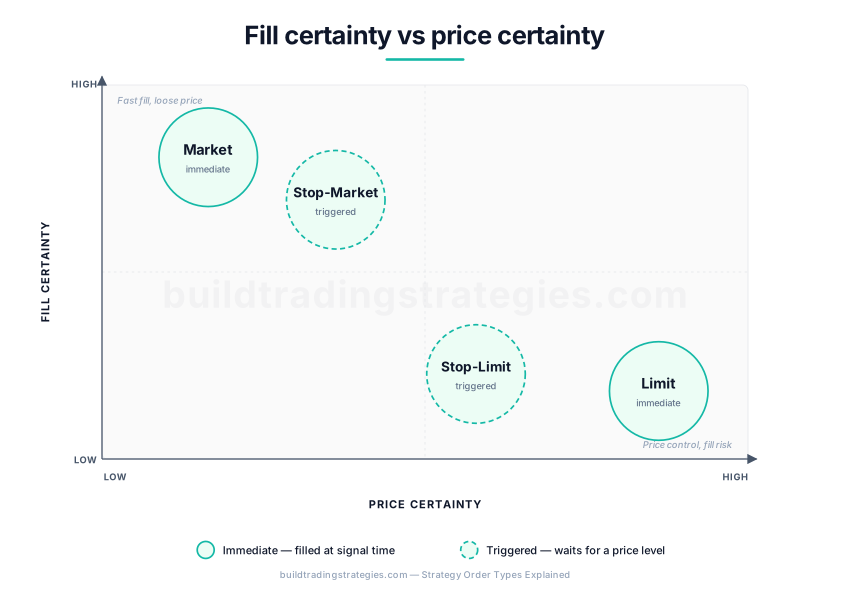
Why Order Type Selection Matters
From a backtesting perspective, order types change three critical things:
- When the trade is allowed to trigger
- At what price the trade is assumed to fill
- Whether the trade fills at all
That third point is often underappreciated. A strategy can look outstanding when every desired entry is assumed to occur neatly, but live trading is less cooperative. Limit orders may never fill. Stop orders may trigger during volatility and fill worse than expected. Market orders may get you in reliably, but at a cost that erodes performance.
So the question is not merely, "Was the signal correct?" It is also, "Was the execution model realistic?"
Market Orders: Highest Execution Certainty, Lowest Price Certainty
A market order tells the system to enter or exit as soon as possible at the best available price. In strategy terms, this is the most direct form of entry. You are saying: the setup is valid, get me in.
From a backtesting point of view, market orders are simple, but simplicity can hide risk. They often make strategies appear robust because trades are consistently taken. That means fewer missed opportunities in the backtest. The danger is that real trading introduces spread, slippage, and fast movement between signal and fill.
Market orders are commonly suitable for:
- Momentum entries
- Urgent exits
- Highly liquid instruments
- Strategies where missing the move is worse than paying a slightly worse price
But the backtesting trap is obvious: if the script does not account for realistic execution frictions, market orders can make a system look cleaner than it will be in production. If you trade through a broker or prop-firm environment, How I Build a TradingView Strategy That Matches My Broker's Constraints adds a practical layer to this problem.
//@version=6
strategy("Market Order Example", overlay=true, pyramiding=0)

fastEMA = ta.ema(close, 10)
slowEMA = ta.ema(close, 20)

longSignal = ta.crossover(fastEMA, slowEMA)

if longSignal and barstate.isconfirmed and strategy.position_size == 0
  strategy.entry("Long-Market", strategy.long)
In this example, the strategy enters using a market order once the crossover is confirmed on bar close. That confirmation matters. Without it, the crossover may appear intrabar and disappear before the candle closes.
Limit Orders: Better Price Control, Lower Fill Certainty
A limit order tells the system to fill only at a specified price or better. For a long entry, that usually means placing the order below the current market and waiting for price to retrace.
This is attractive in backtests because limit entries can improve average entry price and make the risk/reward profile look better. However, there is a major catch: price touching an area conceptually is not the same as getting a realistic fill in live trading. Depending on the market, liquidity, spread, and platform assumptions, a backtest may over-credit fills that would have been missed or only partially filled in reality.
Limit orders are often used in:
- Pullback systems
- Mean reversion systems
- Support/resistance retracement entries
- Profit-taking exits
The main backtesting question is not whether the price level made sense. It is whether your test engine is being too generous about fills.
//@version=6
strategy("Limit Order Example", overlay=true, pyramiding=0)

fastEMA = ta.ema(close, 10)
slowEMA = ta.ema(close, 20)

pullbackSignal = ta.crossover(fastEMA, slowEMA)
limitPrice = close - 20 * syminfo.mintick

if pullbackSignal and barstate.isconfirmed and strategy.position_size == 0
  strategy.entry("Long-Limit", strategy.long, limit=limitPrice)
Here, the signal is confirmed first, but instead of entering immediately, the strategy waits for a retracement to a better price. This may improve entries in a backtest, but it will also reduce participation because some trades will simply run away without filling.
Stop Orders: Confirmation of Movement, But Often Worse Fills
A stop order activates only once price reaches a trigger level. For a long entry, that usually means placing the stop above the current price to confirm breakout strength.
This is a common and sensible choice for breakout systems. It prevents the strategy from entering too early and demands proof that price is moving in the intended direction.
However, from a backtesting perspective, stop orders are frequently misunderstood. Many traders think of the stop price as the fill price. It is not. It is the trigger price. In a fast market, price can move through the level quickly, and the actual fill can be worse.
Stop orders are useful for:
- Breakout systems
- Momentum confirmation
- Entries above resistance or below support
- Avoiding premature entries
The hidden danger is that bar-based backtests can make stop entries look cleaner than live fills really are, especially around gaps or volatile candles.
//@version=6
strategy("Stop Order Example", overlay=true, pyramiding=0)

rangeHigh = ta.highest(high, 20)
breakoutSignal = close > ta.ema(close, 50)
stopPrice = rangeHigh + 5 * syminfo.mintick

if breakoutSignal and barstate.isconfirmed and strategy.position_size == 0
  strategy.entry("Long-Stop", strategy.long, stop=stopPrice)
This script waits until the bar is confirmed, then places a stop order above the recent range high. That is a reasonable breakout model, but the developer still needs to remember that stop-triggered entries can suffer from slippage in live conditions.
Why Bar Confirmation Matters So Much
No discussion of order types is complete without talking about barstate.isconfirmed.
When you do not wait for bar confirmation, you allow the strategy to act on incomplete information. During a live candle, price can move above a breakout level, dip below it, recross an average, or briefly touch a limit area before the candle closes in a completely different shape. That can create trades in a backtest or realtime simulation that would not exist under disciplined, end-of-bar logic.
This matters even more with order types:
- A market order can fire on a crossover that vanishes by close
- A limit order can be placed from a setup that was never truly confirmed
- A stop order can be armed from a false breakout condition developing mid-bar
As covered in the separate backtesting article, bar confirmation is one of the core safeguards in honest strategy testing. It does not solve every realism problem, but it removes a major source of false signals and unstable results.
The Real Backtesting Lesson
When traders say a strategy "stopped working live," the problem is often not the idea itself. The problem is that the backtest assumed an execution model the market never promised.
A market-entry backtest may have ignored slippage. A limit-entry backtest may have assumed ideal fills. A stop-entry backtest may have understated the cost of breakout execution.
That is why order type selection should be treated as part of the strategy edge, not as an implementation detail after the fact.
Conclusion
Market, limit, and stop orders each serve a valid purpose. None is inherently best. What matters is whether the chosen order type matches the strategy logic and whether the backtest models that choice honestly.
- Use market orders when execution matters most
- Use limit orders when price discipline matters most
- Use stop orders when you want price to prove something first
But always remember the deeper point: a strategy is not only its signal. It is also its execution assumptions. If those assumptions are unrealistic, the backtest is not measuring tradable edge. It is measuring a fantasy.
For anyone building TradingView strategies, that is one of the most important distinctions to understand early. From there, the next logical layer is Risk Management & Position Sizing, because order choice and risk model have to agree if the backtest is going to mean anything.
Stop-Limit vs. Stop-Market: A Critical Distinction
The terminology around stop orders creates confusion even among experienced traders. The distinction matters in live execution and should inform how you interpret your backtest.
Stop-Market order: once the trigger price is hit, the order converts to a market order and fills immediately at the best available price. Fill is almost certain. Price is not.
Stop-Limit order: once the trigger price is hit, the order converts to a limit order at a specified limit price. Fill is not guaranteed. In a fast market or a gap, price can move straight through the limit level without filling.
In TradingView backtesting, the `stop=` parameter in `strategy.entry()` models a stop-market behaviour — it triggers at the stop price and assumes a fill. This is optimistic for fast markets and gaps. If your strategy depends on stop entries that would realistically be stop-limit in live execution, you may be overstating fill reliability in the backtest.
For prop-firm traders in particular: knowing whether your broker executes a breakout entry as stop-market or stop-limit is not a minor detail. It determines whether you get into the trade at all during a volatile catalyst.
Gaps and News Events: Where Limit Orders Fail
Limit orders look attractive in backtests because they appear to offer precise, controlled entry prices. The gap problem removes that comfort.
When price gaps — opening significantly above or below the prior close due to overnight news, earnings, or macro events — a limit order that was sitting below the gap simply never fills. The market opened past it. The trade that looked certain in the backtest did not happen.
The reverse is also dangerous: a protective stop order placed below a support level can fill far below that level in a gap, creating much larger losses than the backtest assumed.
The practical implication: strategies that trade around scheduled news events, economic data releases, or instruments prone to overnight gaps need to model this honestly. The backtest should either exclude those bars or use a conservative slippage assumption to account for fill degradation. Treating a gap bar the same as any other bar is one of the cleaner ways to quietly overstate strategy performance.
Order Type Summary
| Order Type | Fill Certainty | Price Certainty | Main Risk in Backtest | Best Use Case | |---|---|---|---|---| | Market | High | Low | Ignores spread and slippage | Momentum, urgent exits, liquid markets | | Limit | Low | High | Overstates fill rate, ignores gaps | Pullbacks, mean reversion, profit targets | | Stop-Market | High | Low | Ignores fast-market slippage | Breakouts, momentum confirmation | | Stop-Limit | Low | Medium | Can miss fill entirely in gaps | Breakouts where price discipline matters |
Understanding where your strategy sits on this table — and whether the backtest is modelling those assumptions honestly — is more valuable than spending another hour optimising the signal logic.