What Makes a Trading Edge?
Learn what a trading edge really is, what it is not, and how beginners can tell the difference between a trade idea, luck, and a repeatable statistical advantage.
One of the most important questions in trading is also one of the most misunderstood: what actually counts as an edge? This guide breaks down the concept of a trading edge in plain language, covering what it is, what it is not, how traders fool themselves into thinking they have one, and how you can start evaluating your own ideas more seriously.
Beginners often think a trading edge is a clever indicator, a profitable-looking chart pattern, or a strategy that had a good month. It is easy to see why. Trading content is full of people presenting setups as if the setup itself is the edge. That's not the right way to look at it.
A trading edge is not just a trade idea. It is not just a nice backtest. It is not just a high win rate. A real edge is something that gives you a repeatable statistical advantage over time, assuming you execute it properly and manage risk sensibly. This includes the real world element which is often overlooked - the real world fees associated with running it - not in the backtesting simualtor - but with a real broker on a real trade execution platform.
A repeatable statistical advantage does not mean it wins all the time. It does not mean it works in every market condition. It does not mean it will last forever. It means that, over a meaningful sample, the method has shown a tendency to produce better outcomes than random decision-making. That is a much more realistic and much more useful definition.
In this article, I want to explain what a trading edge actually is, what it is not, how traders fool themselves into thinking they have one, and how you can start evaluating your own ideas more seriously.
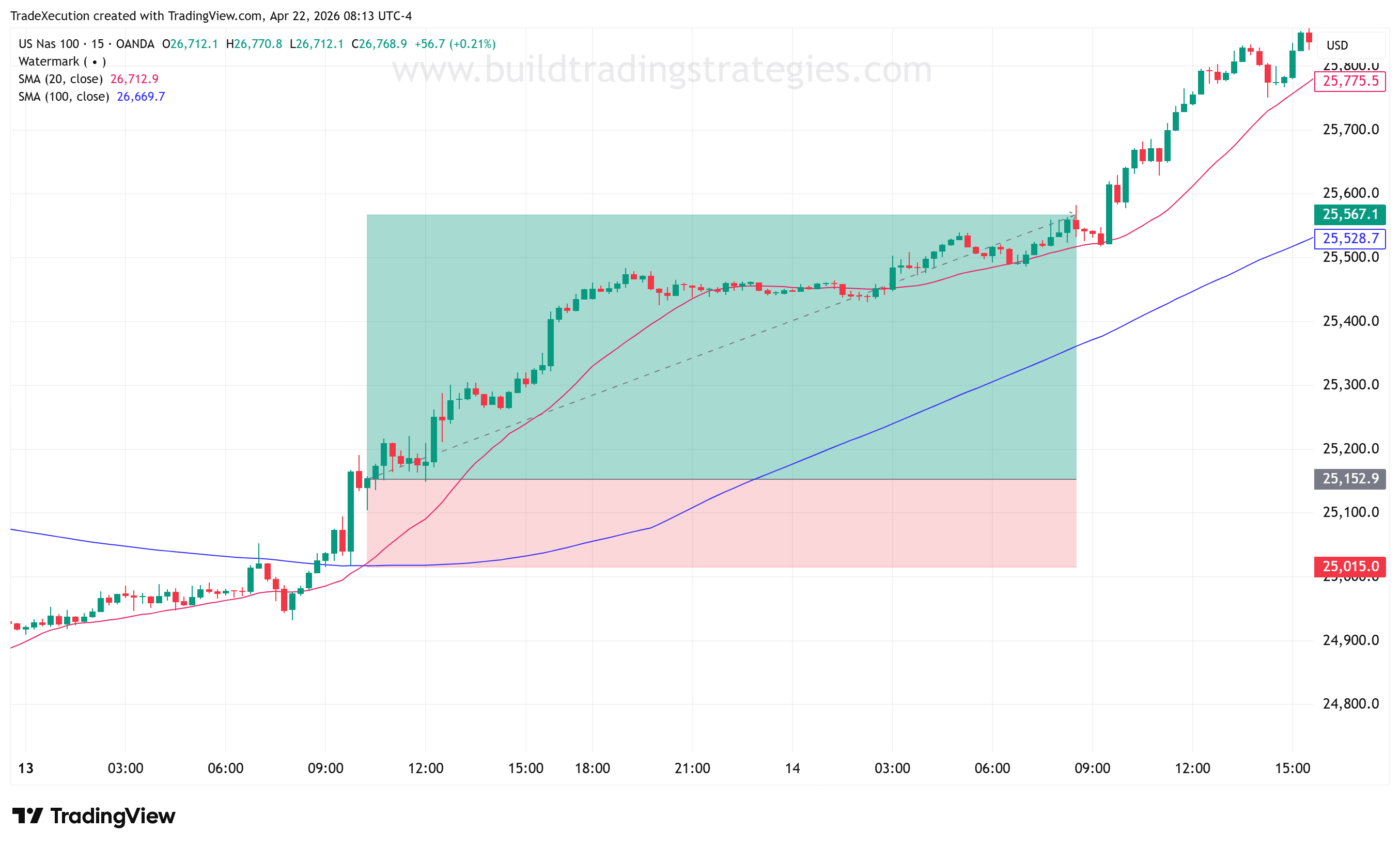
Why the word "edge" causes so much confusion
The word itself sounds stronger than it really is. It makes people imagine certainty, precision, and control. In practice, an edge is usually much messier than that. A real edge often looks like this:
- a modest statistical advantage,
- repeated over many trades,
- with sensible risk control,
- in the right market conditions,
- executed consistently
- catering for real world execution fees
That is much less exciting than the way trading is often sold online, but it is far closer to reality. A strategy does not need to be spectacular to have an edge. It just needs to be good enough, repeatable enough, and robust enough to produce positive expectancy over time.
That question is much better.
A trading edge is not the same as a trade idea
This is one of the first distinctions worth making.
A trade idea is an observation or concept. For example:
- price often reacts at prior highs,
- breakouts sometimes continue strongly,
- oversold markets can bounce,
- pullbacks in strong trends can offer better entries.
Those ideas may be valid observations. But on their own, they are not an edge. They only become candidates for an edge when you define them clearly enough to test them properly. That means specifying things like:
- what exactly qualifies as the setup,
- what invalidates it,
- where the stop goes,
- where the exit goes,
- how the trade is sized,
- what market and timeframe it applies to,
- and whether it behaves well over a meaningful sample.
Until then, you do not have an edge. You have a hypothesis.
That is not a bad thing. Hypotheses are where edges begin. But it is important not to confuse the two.
What a real trading edge usually includes
A real edge is usually made up of several parts working together.
1. A clear idea
The core concept must make sense. That does not mean it needs a complicated theory behind it. Many good strategies are built on simple ideas. But there should be some logic to why the setup might work.
For example: trend-following logic, breakout continuation logic, mean reversion logic, volatility expansion logic, or some behavioural pattern in how traders typically react.
If you cannot explain why the idea might work, even in simple terms, that is a warning sign.
2. Clear rules
A vague idea is not enough. A real edge needs rules that can be followed repeatedly. If the setup depends on intuition that changes from day to day, it becomes very hard to evaluate honestly.
Rules do not need to be perfect, but they do need to be clear enough that two people looking at the same system would broadly understand what counts as a valid trade.
3. Positive expectancy
This is one of the key tests. Over time, the strategy should show that it makes more on average than it loses.
That does not mean every month is profitable. It means that across a meaningful sample, the average outcome per trade is positive enough to matter.
4. Enough evidence
A system that looks good over 15 trades is not proven. A system that shows resilience over a much larger sample deserves more attention.
Without enough evidence, it is very difficult to separate luck from skill.
As a rough working guide — and it genuinely is only a rough guide, because what counts as "enough" depends on the size of the edge you are trying to detect — practitioners often use something like:
- Fewer than ~30 trades — treat any result as anecdotal. Any apparent edge can be random.
- ~30 to ~100 trades — the first point at which a strong edge starts to look different from noise, but a weak edge is still indistinguishable from random.
- ~100 to ~500 trades — moderate confidence; most realistic retail edges need a sample this size before you can start to trust the headline numbers.
- 500+ trades across varied market conditions — strong evidence, especially if the trades span multiple market regimes (trending, ranging, volatile, calm).
The underlying statistical point is that for a small edge (say +0.1R per trade expectancy), the standard error of the sample mean shrinks with the square root of the number of trades — so doubling your sample does not halve your uncertainty; quadrupling it does. That is why 500 trades is a meaningful threshold for a modest edge, and why 50 trades can look great by pure chance even with no real edge.
5. Risk control
An edge is not just about entries. A strategy with decent entries but reckless risk management can still fail badly. That is why position sizing, stop placement, and exposure control are part of the edge in practice.
A fragile strategy is not made robust just because the entry pattern looks clever.
6. Consistency of execution
Even a good strategy can fail in the hands of a trader who cannot follow it consistently. This is why a true edge is always partly about the method and partly about whether the trader can actually execute it properly.
What a trading edge is not
This section matters because a lot of beginners mistake attractive-looking things for genuine edge.
A trading edge is not:
- one profitable week,
- one nice equity curve,
- one cherry-picked example,
- a high win rate on its own,
- a complicated indicator stack,
- a social media screenshot,
- or somebody else saying a setup works.
It is also not:
- "I have seen this pattern work a few times,"
- "this looks obvious on the chart,"
- or "I feel like this has an advantage."
All of those things may be starting points. None of them are strong enough on their own.
If the evidence is weak, the edge is unproven. That does not mean the idea is wrong. It just means you do not know yet.
Why beginners so often think they have an edge when they do not
This happens all the time, and it happens for understandable reasons.
Pattern recognition is seductive
Humans are very good at noticing patterns, even when the pattern is weak, incomplete, or partly imagined. When you spend enough time staring at charts, it becomes very easy to believe you are seeing repeatable opportunity everywhere.
Sometimes you are. Often you are just seeing noise plus hindsight.
Recent wins feel like proof
A strategy that wins six trades in a row can feel incredible. But short winning streaks happen all the time, even in mediocre systems. A few good outcomes do not tell you much on their own.
Nice charts are persuasive
A clean chart with a few perfect examples is emotionally convincing. That is one reason traders get misled by screenshots. A screenshot shows possibility. It does not show sample size, missed trades, drawdowns, execution issues, or the dozens of times the pattern failed.
Complexity feels intelligent
Beginners often assume a complicated system must be more sophisticated and therefore more likely to work. In reality, complexity often hides weak logic rather than improving it.
A simple idea with clear evidence is usually more valuable than a complicated one that sounds impressive.
The difference between a fragile edge and a robust edge
This is one of the most important distinctions to understand.
A fragile edge is one that only looks good under narrow conditions. For example:
- it only works on one market and one short time period,
- it falls apart if you change a setting slightly,
- it relies on perfect fills,
- it has too few trades,
- or it depends on very specific conditions that may not repeat often.
A robust edge is not perfect, but it has broader support behind it. For example:
- it holds up across more data,
- it still makes sense if you slightly adjust inputs,
- it behaves in a believable way,
- it has enough trades to study,
- and it does not depend on unrealistic assumptions.
Robust does not mean immortal. Markets change. Strategies decay. But robustness does mean the strategy has a much stronger case behind it than a fragile, over-tuned system.
What evidence should make you take an edge seriously?
You do not need absolute proof. Trading rarely offers that. But you do want enough evidence that the idea deserves respect.
For me, the main signs are:
1. The logic makes sense
You should be able to explain, in plain language, why the setup might have an advantage.
2. The rules are specific
You should know what qualifies, what invalidates, and how the trade is managed.
3. The backtest is believable
The results should make sense, use realistic assumptions, and avoid obvious traps like overfitting or impossible execution.
4. The sample is meaningful
The trade count and historical coverage should be large enough to give the results some weight.
5. The drawdown is survivable
A profitable system that is emotionally or financially impossible to follow is of limited practical value.
6. The strategy matches the trader
A system can have edge on paper and still be the wrong fit for the person trading it. For example, a trader who hates low win-rate systems may sabotage a perfectly valid trend-following approach simply because they cannot emotionally tolerate the losing streaks.
That does not mean the system lacks edge. It means the fit is poor.
Edge is conditional, not universal
This is a very important idea.
A lot of beginners talk about strategies as if they either "work" or "do not work." Real trading is rarely that neat.
Many valid strategies are conditional. They work better in some environments than others. For example:
- trend-following systems often do better in directional markets,
- mean reversion systems often do better in stable, oscillating conditions,
- breakout systems may behave differently depending on volatility regime,
- and some systems that worked for years can weaken when market structure changes.
That does not necessarily mean the edge was fake. It may mean the edge was real, but conditional.
This is one reason why serious traders spend so much time on context, testing, and ongoing evaluation.
A strategy does not need to work everywhere to have edge. But you do need to understand where that edge is likely to be strongest and where it may struggle.
Why execution and risk are part of the edge
Beginners often isolate the entry too much. They think the edge is all about finding the perfect signal.
But in practice, the result of a strategy is shaped by far more than the entry alone. It also depends on:
- how losses are controlled,
- how winners are allowed to run or not,
- how position size changes risk,
- how often the setup occurs,
- how slippage and costs affect outcomes,
- and whether the trader can actually follow the plan.
That is why two traders can use roughly the same idea and get very different results.
An edge is not just the signal. It is the whole process around turning the signal into a repeatable method.
The role of backtesting
Backtesting is one of the best ways to investigate whether an idea might contain real edge.
It is not a crystal ball. It does not guarantee future performance. But it does help you move from opinion to evidence.
A proper backtest helps answer questions like:
- did this idea show positive expectancy?
- how often did it occur?
- how severe were the losing periods?
- did it only work in one narrow patch of history?
- does the result still make sense after costs and realistic assumptions?
That is a far more useful way to think than simply asking whether the chart looks good.
A backtest does not prove an edge exists forever. But it is one of the best tools for evaluating whether an idea deserves serious attention.
The role of forward testing
Even a promising backtest is not the end of the process. At some point, you need to see how the strategy behaves outside the historical test, ideally in a more realistic forward environment.
That might mean:
- paper trading,
- replay testing,
- demo trading,
- or going live at very small size.
This matters because some ideas look good historically but become much harder to follow in real time.
Forward testing helps answer a different question:
> Can this edge be executed in practice, not just admired in hindsight?
That is a major step.
How to think about edge as a beginner
If you are still new, I would keep the definition simple.
A trading edge is:
> A repeatable way of trading that has shown enough evidence of a statistical advantage to be worth taking seriously.
That evidence should include:
- clear logic,
- clear rules,
- enough trades,
- positive expectancy,
- sensible drawdown,
- and realistic execution.
That is a much healthier definition than:
- "this pattern looks powerful,"
- "this indicator works,"
- or "someone online said this strategy is profitable."
Those things are not enough.
A practical beginner checklist
When you think you may have found an edge, ask yourself:
- Can I explain why this setup might work? Not perfectly. Just clearly.
- Are the rules specific? Could I write them down without hand-waving?
- Has it been tested properly? Or am I mostly relying on a few nice examples?
- Is the sample meaningful? Do I have enough trades to take the result seriously?
- Is the edge still there after realistic costs and assumptions? Or is the result only attractive on paper?
- Can I actually execute it? Not in theory. In practice.
- Does it fit me? Can I handle the losing streaks, the frequency, and the style of the system?
If too many of those answers are weak, the edge is probably still unproven.
The uncomfortable truth about trading edges
A real edge is usually smaller and less glamorous than beginners hope.
It is often:
- less obvious,
- less frequent,
- more conditional,
- more dependent on discipline,
- and more vulnerable to change than people expect.
That can sound discouraging, but I actually think it is helpful.
Because once you stop looking for magic, you can start doing real work:
- defining ideas properly,
- testing them honestly,
- filtering out weak evidence,
- managing risk,
- and gradually building methods that deserve confidence.
That is where progress starts.
Final thought
A trading edge is not a promise of easy money. It is not certainty. It is not a shortcut around losses.
It is a repeatable advantage, backed by evidence, expressed through rules, and made useful through disciplined execution.
That may sound less exciting than the way trading is often marketed, but it is much closer to the truth.
And in the long run, truth is far more useful than hype.
If you can learn to think about edge this way, you will already be approaching trading more seriously than most beginners.
Where to go next
If this article helped, the next step is to learn how to evaluate backtest results more carefully and how to avoid being misled by attractive numbers.
Recommended next reading: